
The Family Vault – A Web3 Legacy
Contents
- 🏦 What if Your Family Had Its Own Bank?
- ⚰️ When a Parent Passes Away
- 💳 Pocket Money of the Future
- 👨👩👧 A Real-World Example
- 💡 Everyday Use Cases
- 🧠 Smart Contracts: The Next Layer
- 🧩 In Summary
🏦 What if Your Family Had Its Own Bank?
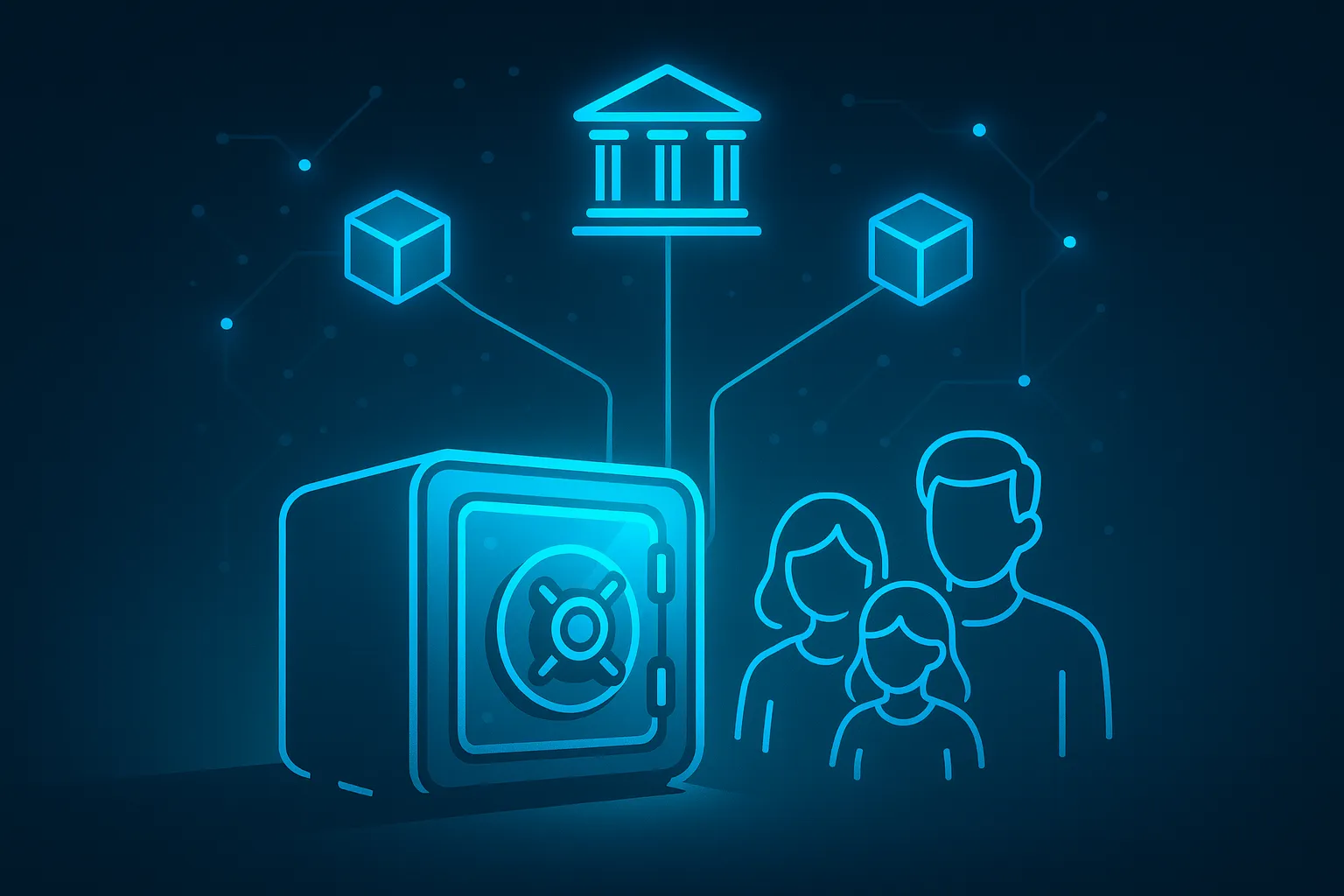
Imagine your family owning a digital safe — a 2-out-of-3 multisig vault.
Inside are your shared savings, crypto investments, and even your collective future.
- The father holds one key (cold wallet).
- The mother holds another (mobile wallet).
- The child also holds a key, learning responsibility through participation.
👉 Rule: any withdrawal requires two signatures out of three.
No single person can move funds alone.
Trust is coded, not assumed.
In one sentence: it’s your family’s personal Web3 bank,
where security and education go hand in hand.
⚰️ When a Parent Passes Away
In the traditional world, the bank freezes everything.
Paperwork, notaries, and months of waiting follow.
In the Web3 world, the multisig simply continues to work:
- The mother and the child already hold the two required keys.
- Together, they can transfer funds securely to their own wallets.
- No paperwork. No intermediaries. Inheritance becomes instant and safe.
Even better, smart rules can be pre-programmed:
- The child’s full access unlocks automatically at legal age.
- Until then, they co-sign and learn how real security works.
What used to take months now happens automatically — by design.
💳 Pocket Money of the Future
The family vault isn’t just about inheritance — it’s also a tool for daily life.
Each child has their own wallet connected to a crypto debit card.
Parents can top them up directly from the family multisig.
👉 Example: weekly allowance of €50, sent automatically from the vault.
Spending is visible, capped, and educational.
Kids learn to manage, sign, and take ownership.
The vault becomes:
- 🧠 A financial education tool – learning by doing.
- 🏛️ A transmission tool – wealth flows naturally, even after death.
- 💳 A daily tool – for allowances, shared expenses, and savings.
In short: you replace the bank with your own Web3 family vault —
secure, transparent, and truly educational.
👨👩👧 A Real-World Example
Let’s take a family with two parents and two teenagers (14 and 17 years old):
graph TD
    A["🏛️ Vault Multisig (Safe 2/3) <br>📦 Shared Family Vault <br>• Savings (trips, etc.) <br>• Pocket money"]

    F["👨 Dad (Cold Wallet) <br>🔑 Main key <br>🛡️ Maximum security <br>🚫 Not for spending"]

    G["👨 Dad (Hot Wallet) <br>💳 Personal expenses <br>💸 Personal crypto card <br>❌ Not linked to vault"]

    H["👩 Mom (Hot Wallet) <br>🔑 Daily key <br>⚡ Quick access <br>✅ Easy validation"]

    I["👧 Daughter (17y, Hot Wallet) <br>🎓 Student expenses <br>💳 Crypto card <br>🪙 Can co-sign with Mom"]

    J["👦 Son (14y, Hot Wallet) <br>💰 Limited allowance <br>💳 Crypto card <br>📚 Learning phase"]

    F --> A
    H --> A
    I --> A
    J --> A
G --> F- Dad
- Uses a hot wallet for daily spending.
- Keeps a cold wallet as his main key in the vault.
- Mom
- Has a hot wallet and acts as daily co-signer.
- Kids
- Each has their own wallet:
- The 14-year-old starts learning with limited permissions.
- The 17-year-old already manages part of her student expenses.
- Each has their own wallet:
👉 The vault operates in 2-out-of-3 mode:
- Dad (cold) + Mom (hot) → ✅
- Dad (cold) + Daughter (hot) → ✅
- Mom (hot) + Daughter (hot) → ✅
At least two signatures are always required — meaning no one can act alone.
💡 Everyday Use Cases
Here are a few examples of how a family multisig works in real life:
Family savings:
A shared Safe for vacations or projects, managed with 2/3 signatures.Pocket money:
Each child has a crypto card with spending limits.
Parents top it up automatically from the vault.Security:
If Dad loses his hot wallet, Mom + Cold wallet still keep control.Inheritance:
If one parent passes away, the other and the adult child keep full access.
🧠 Smart Contracts: The Next Layer
A multisig is already a strong foundation.
Smart contracts take it one step further — adding rules that enforce themselves.
🔒 Age-Driven Permissions
Children hold signatory wallets, but their rights evolve automatically:
- Before 16 → symbolic signature only.
- At 16 → co-signing rights for small expenses.
- At 18 → full access as adult signatory.
👉 Benefit: rights evolve naturally, no manual updates needed.
💸 Smart Spending Caps
Define spending limits per wallet:
- e.g. max $200/week per child, $1 000/month per parent.
Ideal for budgeting, allowances, or protection against hacks.
👉 Benefit: safety + financial discipline.
🪙 Goal-Based Vaults (Time-Locked)
Create a second vault for specific goals (vacations, car, studies).
Funds remain locked for a set period (e.g. 12 months).
They unlock automatically once the time expires — with multisig approval.
👉 Benefit: encourages planning and delayed gratification.
🧾 Automated Allowances
Smart contracts can distribute funds automatically:
- Weekly allowance to each child’s wallet.
- Monthly “groceries” budget to the parent’s wallet.
👉 Benefit: automation, fairness, zero forgetfulness.
⚰️ Automatic Inheritance
The contract checks a periodic “proof of life” (a ping or transaction).
If one key remains inactive too long, rights shift to survivors.
👉 Benefit: inheritance without lawyers or delays.
🔐 Multiple Vaults for Different Goals
- One vault for long-term savings (locked).
- One for daily expenses (topped up monthly).
- One for DeFi experiments (higher risk).
👉 Benefit: clarity, safety, and better risk management.
🧩 In Summary
Smart contracts remove the human factor — forgetfulness, abuse, or loss —
by turning family rules into code.
Combined with a multisig, they create a living family financial system
that is secure, educational, and fully autonomous.
The most powerful ideas:
- Spending caps
- Age-based access
- Automated allowances
- Inheritance without bureaucracy
Together, they build a Web3 family system — fair, transparent, and ready for the future.
“Financial sovereignty begins at home.”