
The Agentic Revolution: How AI Is Already Changing Work
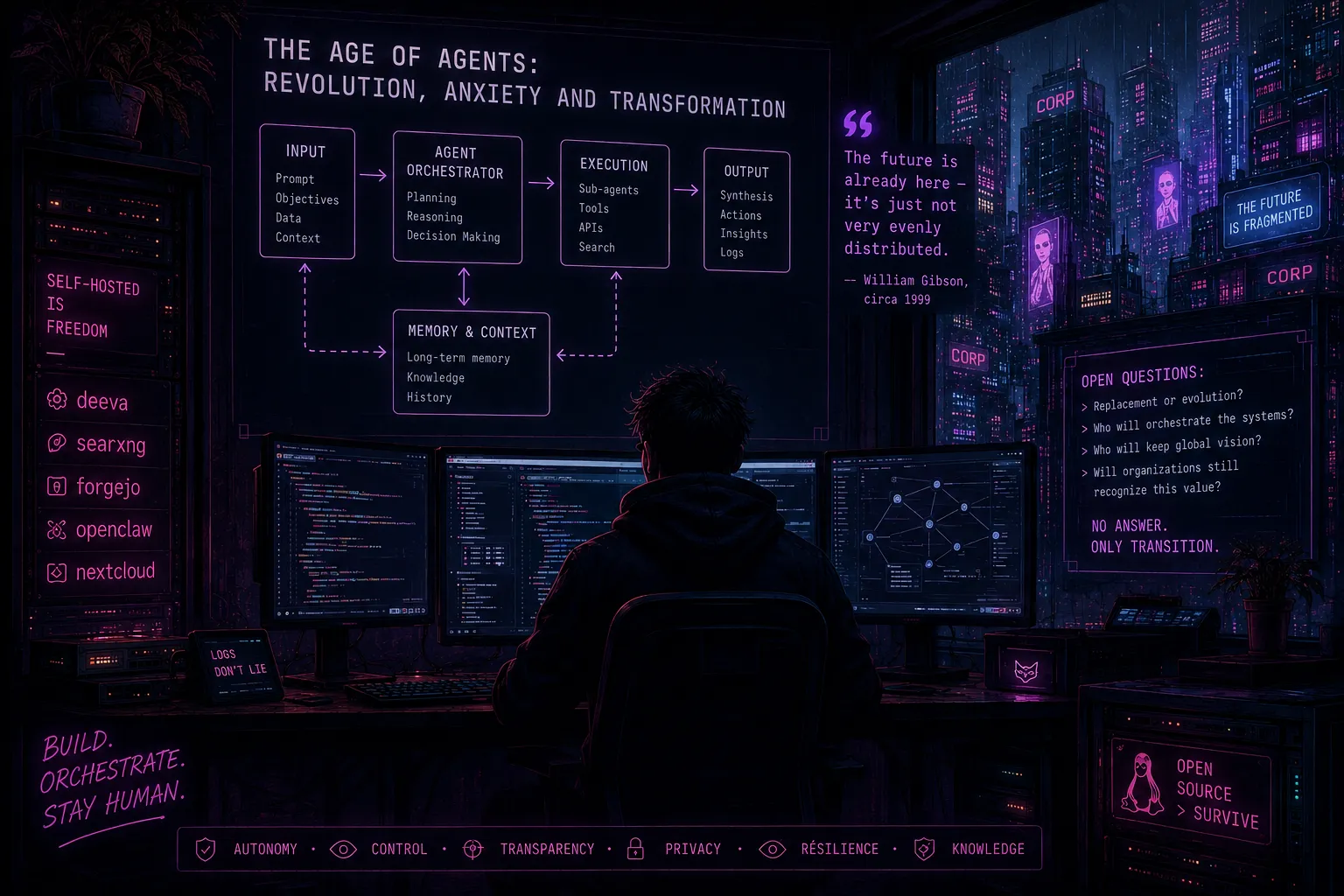
The Agentic Revolution: AI Is Already Changing Work
As I write this, my own agents are already running in parallel.
Some are reviewing code. Some are looking for performance issues. Others are synthesizing decisions I would not have had time to revisit on my own.
A few years ago, that sentence would have sounded like science fiction.
Today, it is my working environment.
Over the past few months, something has changed.
Not just another tech trend. Not just another framework. Not just a smarter chatbot.
A new cognitive layer is emerging.
And for the first time in a very long time in my career, I genuinely feel we are facing a shift on the scale of:
- the arrival of the Internet,
- the Web,
- mobile,
- cloud computing,
- or even virtualization.
But this time, the change touches intellectual work itself.
I come from a different Internet
I have been a developer and software architect for more than 30 years.
I started on a Commodore 64. I wrote small games in BASIC. I made music on trackers with improbable time signatures. I lived through BBSes, Gopher, CGI in C++, the early Web, university CPU constraints, improvised servers, and hand-built networks.
I come from an Internet where you had to understand systems in order to build anything meaningful.
This is not nostalgia. It is my frame of reference. I have seen disruptions arrive, get mocked, and then become the invisible infrastructure of the world.
I have lived through:
- Web 1,
- Web 2,
- cloud,
- mobile,
- DevOps,
- blockchain,
- DeFi,
- and now agentic AI.
And honestly? I have never seen acceleration this brutal.
Vibe coding is already old news
For a while, many people discovered “vibe coding”.
Ask an AI to generate code quickly. Create apps in a few prompts. Impress everyone with speed.
But that is only a transitional phase.
The real shift is somewhere else.
The real shock is not that an AI can write a function.
The shock is that we are starting to assemble entire systems around cognitive roles.
The future is probably not:
- one magical super assistant,
- a developer replaced by a chatbot,
- or an omniscient AI doing everything on its own.
The future looks much more like:
- constellations of specialized agents,
- parallel reviewers,
- dedicated workers,
- cognitive pipelines,
- persistent memory,
- orchestration,
- governance,
- and humans who know how to steer all of it.
In other words: this is no longer just a tool. It is a miniature organization.
Concretely, we are no longer just asking AI to answer. We are starting to hand it entire chunks of how work gets organized.
Today, on my own projects, I already use:
- parallel workers,
- performance reviewers,
- reliability reviewers,
- cross-synthesis systems,
- agentic workflows,
- and automated validation chains.
We are no longer in the mere “copilot” era.
We are entering the age of distributed cognitive systems.
What actually worries me
The problem is not technical.
The problem is human.
Many companies are probably going to make a monumental mistake.
They will start by cutting jobs. Automating aggressively. Shrinking teams. Replacing entire roles with AI workflows.
And for a while, it will probably look like it works.
The dashboards will be green. Costs will go down. Executives will feel like they have gained efficiency.
Then the systems will start losing coherence.
But by then, they may discover something essential far too late:
Agents replace execution much more easily than they replace systems-level judgment. They can produce quickly. But they do not always know why something should be produced, or what consequences a decision will have across the whole system.
Organizations will probably lose:
- architects,
- cross-functional people,
- people who know how to orchestrate,
- people who understand complex interactions,
- people capable of maintaining global system coherence.
And the most worrying part?
Many hierarchical structures already struggle to tell the difference between:
- an executor,
- and a systemic thinker.
A fear many people already feel
Many developers feel something they cannot quite put into words yet.
A quiet form of anxiety.
If you work in tech, you may have felt this unease already. Not necessarily panic. More like a question sitting at the back of your mind: where do I fit in this new world?
But being afraid does not mean being obsolete. Sometimes it simply means you have understood that something real is moving.
Some people refuse to see what is coming. Others believe they are impossible to replace. Others still dismiss all of this as a passing fad.
I work with extremely competent people. But I also see a lot of denial.
And honestly, I understand the fear.
There is an almost absurd double bind here.
When you automate part of your own work, it can feel as if you are helping build the case for your own disappearance. But if you refuse to play along, you risk being seen as a blocker, a holdout, someone preventing the organization from moving forward.
So many people do the exact opposite of what fear tells them to do. They adapt even faster. They show they can use AI, orchestrate with it, accelerate with it. As if they had to prove, almost too loudly, that they still deserve their place in a system that is already changing.
It is almost ridiculous at times. But more than anything, it is deeply human.
Because for the first time, it is not only the hand that is being challenged. It is part of reasoning, analysis, and intellectual execution. And even if that is not the whole of human intelligence, it is already enough to move the ground beneath our feet.
Not completely. But enough to disrupt the balance of the market.
“The future is already here — it’s just not very evenly distributed.”
— William Gibson, circa 1999
Many people are starting to feel this future taking shape around them.
The problem is that it is not evenly distributed.
Some are already living in this new reality. Others still refuse to see it at all.
Recognizing the change is already a form of adaptation.
Why I keep going anyway
Despite these concerns, I remain deeply fascinated.
Because this revolution can also augment humans instead of simply replacing them.
Agents already make it possible to:
- orchestrate complex tasks,
- massively increase productivity,
- build systems that would once have been impossible to maintain alone,
- explore much faster,
- think differently.
I do not feel replaced.
I feel transformed.
My role is gradually evolving:
- less pure execution,
- more orchestration,
- more governance,
- more global vision,
- more synthesis,
- more cognitive supervision.
And honestly, this is probably what many companies still do not understand.
The real question
The real question is not:
“Will AI replace developers?”
The real question is:
“Which kinds of people will know how to work WITH agentic systems?”
And above all:
“Will organizations still know how to recognize the value of people who can orchestrate this new complexity?”
I do not have the answer yet.
But we have already entered this transition.
And honestly? I do not think many people realize just how much the world of work is already changing.
This is probably only the beginning
And somewhere between technological fascination and human anxiety, I sometimes feel like I am living in a strange artisanal version of an old cyberpunk novel.
Except this time, it is not science fiction anymore.
“Man has, as it were, become a kind of prosthetic God. When he puts on all his auxiliary organs he is truly magnificent; but those organs have not grown on to him and they still give him much trouble at times.”
— Sigmund Freud, Civilization and Its Discontents (1930)
The question is no longer whether this revolution is coming. It is already here. The real question now is what we choose to do with it.