What Exactly *Is* a Bitcoin? Understanding the Mathematics of Digital Scarcity
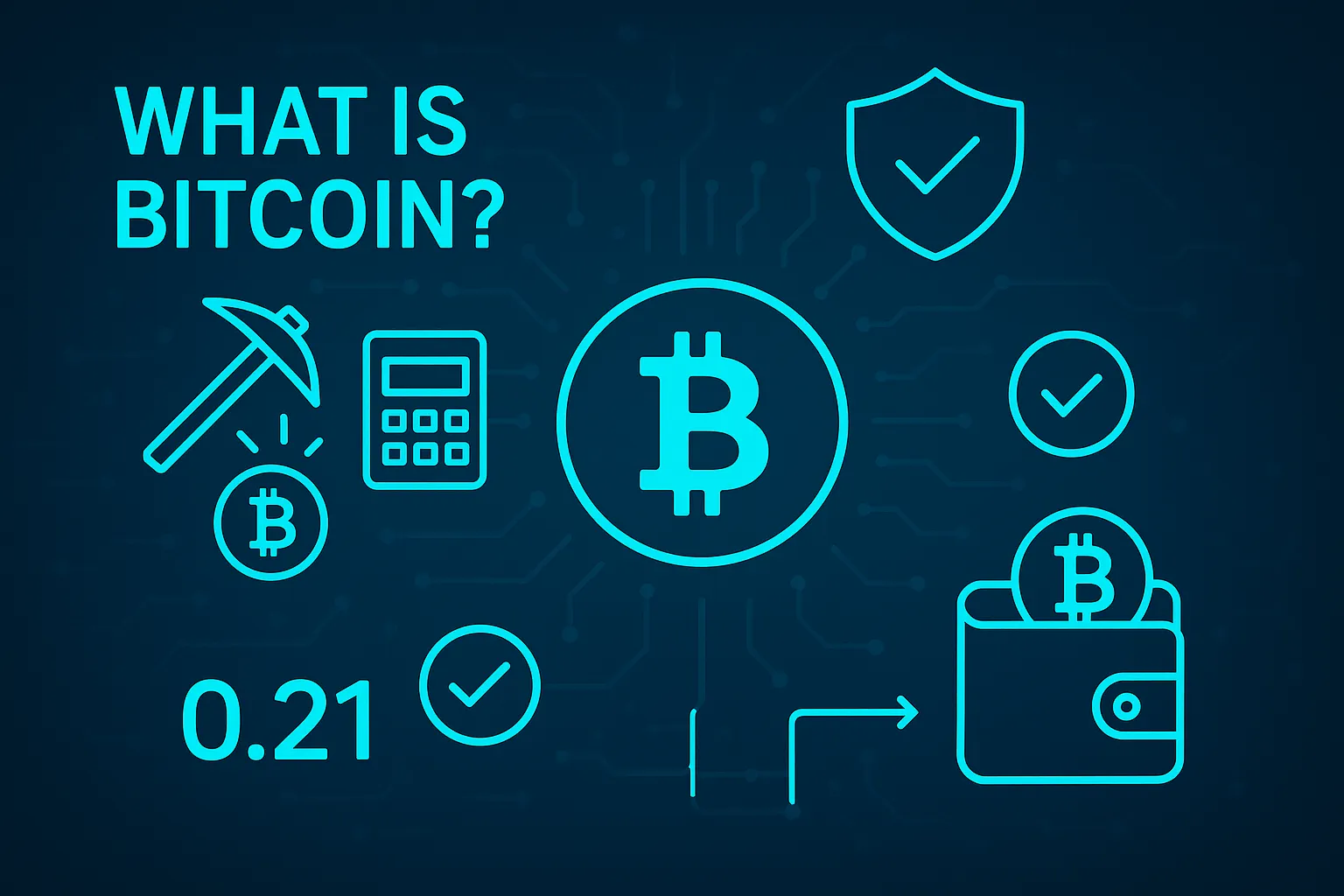
🪙 What Exactly Is a Bitcoin?
Bitcoin is not just a “digital coin.”
It’s the first monetary system in history that runs without trust, without banks, and without borders.
When Satoshi Nakamoto published the Bitcoin White Paper in 2008, the world had just gone through a massive financial crisis.
People realized that trusting institutions had a cost — inflation, censorship, and dependence.
Bitcoin was born as an antidote.
“A purely peer-to-peer version of electronic cash.” — Satoshi Nakamoto, 2008
⚙️ 1. What a Bitcoin Really Is
A Bitcoin isn’t a token you can touch or a file you can copy.
It’s an entry in a global, public ledger called the blockchain — a decentralized database recording every transaction since 2009.
Owning Bitcoin simply means:
“This address currently holds X satoshis.”
Each transaction updates that state transparently across thousands of computers worldwide.
⛏️ 2. How Bitcoins Are Created: Mining and Proof of Work
New bitcoins are born through mining, the process of securing and validating transactions.
Miners compete to solve a cryptographic puzzle — finding a hash (SHA-256) below a certain threshold.
The first one to succeed adds a new block to the chain and earns a block reward: newly created bitcoins plus transaction fees.
This process is called Proof of Work.
It’s what gives Bitcoin its cost, security, and resistance to manipulation.
🧮 3. Why There Will Only Ever Be 21 Million
The Bitcoin protocol hard-codes a finite supply: 21,000,000 BTC.
Every 210,000 blocks (~4 years), the block reward is cut in half — a mechanism called the halving.
This geometric reduction ensures that the total number of bitcoins approaches 21 million but never exceeds it.
Even if one miner tried to mint more,
every other node in the network would reject it — consensus protects scarcity.
⚖️ 4. The Halving: Engine of Scarcity
Here’s how the reward has evolved:
| Year | Block Reward | Notes |
|---|---|---|
| 2009 | 50 BTC | Genesis era |
| 2012 | 25 BTC | 1st halving |
| 2016 | 12.5 BTC | 2nd halving |
| 2020 | 6.25 BTC | 3rd halving |
| 2024 | 3.125 BTC | 4th halving |
By ~2140, the reward will hit zero —
and the last Bitcoin will be mined.
From that point on, miners will be paid only through transaction fees.
🔐 5. How Transactions Are Validated
Every transaction is digitally signed using private keys.
Nodes verify that:
- The coins being spent actually exist.
- The signature matches the public address.
- The same coins haven’t been spent twice.
This decentralized verification replaces the need for banks, auditors, or governments.
Consensus itself is the trust mechanism.
🗝️ 6. Ownership: Private Keys and Addresses
Each Bitcoin address is derived from a public key, which in turn comes from a private key.
Your private key is the only proof that those bitcoins belong to you.
If you lose it, the coins are gone forever.
If someone else gets it, they own them.
Hence the golden rule:
“Not your keys, not your coins.”
🧭 7. The Sovereignty Threshold: Why 0.21 BTC Changes Everything
7.1 A Finite System, a Finite Share
Bitcoin is mathematically capped at 21 million coins.
Each Bitcoin is divisible into 100 million satoshis,
meaning there will only ever be 2.1 quadrillion satoshis in existence.
If these were evenly distributed across the world’s 8 billion people,
each person would hold 262,500 sats — that’s just 0.002625 BTC.
Owning an entire Bitcoin is already out of reach for most humans.
But 0.21 BTC — that’s still achievable today.
7.2 What 0.21 BTC Represents
Holding 0.21 BTC means you own 1 out of every 100,000 bitcoins that will ever exist.
It makes you a co-owner of the monetary network itself,
not just a participant in it.
It’s the point where you transition from user to sovereign actor —
a stakeholder in the world’s first decentralized monetary system.
7.3 Why This Number Isn’t Random
- 0.21 BTC = 1% of 21 BTC, a perfect fractal echo of Bitcoin’s total supply.
- It’s a proportional mirror of the entire network’s cap (21 million).
- It defines a psychological and symbolic threshold —
where you hold enough Bitcoin to be financially independent of the legacy system.
7.4 The Sovereignty Threshold
Reaching 0.21 BTC means:
- You own a mathematically scarce slice of a global asset.
- You’re insulated from inflation and monetary debasement.
- You hold a transferable, borderless store of value secured by energy, math, and time.
- You’ve achieved a form of digital citizenship in the Bitcoin economy.
💬 Put simply:
Owning 0.21 BTC means you don’t use the system —
you are the system.
7.5 The Future Perspective
As adoption grows, 0.21 BTC will become the new “whole coin.”
What 1 BTC represents today — a life-changing sum —
will one day be represented by 0.21 BTC for the next generation.
Those who secure their share early will be among the few holding
a finite piece of the world’s first incorruptible monetary network.
🧠 8. Why Bitcoin Can’t Be Faked or Inflated
- The code is open-source, transparent, and enforced by every node.
- Proof of Work makes attacks astronomically expensive.
- No central entity can alter the supply, seize funds, or censor transactions.
- Bitcoin’s scarcity is mathematical, not political.
Bitcoin is not a company, not a government project, not a promise —
it’s a protocol for financial truth.
🏁 9. Conclusion: The Money of the Long Term
Bitcoin is more than an asset; it’s a shift in how humanity defines value and ownership.
Every ten minutes, another block is mined —
and we inch closer to the day the final Bitcoin is created, around 2140.
When that happens, no new supply will ever appear again.
And those who understood early — those who crossed the 0.21 BTC threshold —
will stand among the first generation of truly sovereign individuals.
Bitcoin is not about getting rich.
It’s about never being poor again.